
Table of Contents
Is Medical Coding a Good Career in 2027?
Quick answer: Yes, medical coding is still a good career in 2027, but the job is changing. AI now handles a growing share of routine coding, so employers increasingly want coders who can review AI suggestions, work through complex records, and support audits and compliance. Coders who build these skills have a promising future. Those who rely only on memorising codes will find the road harder.
Key takeaways
- Healthcare keeps generating more records, claims, and compliance work. US government data projects 7% job growth for medical records specialists from 2024 to 2034, well above the 3.1% average for all occupations.
- AI is automating simple, repetitive coding. It is not removing the need for human judgement.
- Certification pays. AAPC’s salary report shows certified professionals earn about 21% more on average than non-certified colleagues (US data).
- The strongest path is to become an AI-assisted coder first, then grow into auditing, quality, or team leadership.
- An institute with an AI-integrated curriculum, hands-on practice, and honest placement support can make a real difference to how quickly you start working.
If you are thinking about a career in medical coding, you have probably noticed two very different kinds of headlines. One says it is a stable, desk-based career with plenty of openings. The other says artificial intelligence is about to take over the whole profession. Both cannot be completely right, so which one should you believe?
The honest answer sits somewhere in the middle. In this guide, we explain what medical coding involves, how AI is actually being used, what it means for freshers, and how to prepare so that technology works for you rather than against you. We train healthcare professionals in Kerala, so we follow how hiring needs in this industry shift very closely. What follows is our practical view, not a sales pitch.
What Does a Medical Coder Do?
Medical coding is the process of turning information in a patient’s medical record, such as diagnoses, procedures, and services, into standardised alphanumeric codes. These codes allow hospitals, insurance companies, and government programmes to understand what care was given and how it should be paid for.
Three code sets form the foundation of the work:
- ICD-10-CM is used to code diagnoses and medical conditions.
- CPT is used to code procedures and clinical services.
- HCPCS Level II is used to code supplies, equipment, and certain services that CPT does not cover.
A coder reads clinical documentation, selects the correct codes, follows official guidelines, and makes sure the final claim reflects what actually happened during the patient’s care. This work sits inside a larger process called revenue cycle management (RCM), which includes claim submission, payment follow-up, and denial management. One wrong code can delay a payment or trigger a denial, which is why accuracy is valued so highly in this profession.
In simple terms, accurate coding helps insurance claims get paid, keeps medical records clear, prevents billing mistakes, and makes healthcare data more useful for everyone involved.
Is Medical Coding Still in Demand in 2027?
Yes, and there are a few clear reasons why.
The numbers provide useful context. According to the US Bureau of Labor Statistics (BLS), employment of medical records specialists is projected to grow by 8 percent from 2025 to 2035, compared with 3 percent growth across all occupations. The BLS also projects approximately 14,000 openings each year on average. These figures relate to the broader US medical records specialist occupation, which includes coding-related responsibilities. They should not be interpreted as direct medical coder vacancies or as a forecast of employment opportunities in India.
- Healthcare data keeps growing. More patients, more treatments, and more digital documentation mean more records that need to be coded correctly.
- Accuracy and compliance matter. Payers and regulators expect claims to be supported by documentation, and healthcare organisations need trained people to make sure they are.
- Employers say coders are hard to find. May 2025 MGMA poll found that 9% identified coders as their hardest-to-recruit staff role
- India is a major RCM hub. A large share of coding and billing support for international healthcare providers is handled by teams in India, including cities across Kerala.
- International pathways exist. Specialised areas such as UAE revenue cycle management and Australian clinical coding open doors beyond the traditional US-focused roles.
There is one honest caveat. Entry-level hiring is more competitive than it was a few years ago, and employers now prefer candidates who are certified, properly trained, and comfortable with modern tools. Demand has not disappeared. It has shifted towards people with stronger skills.
How Is AI Changing Medical Coding?
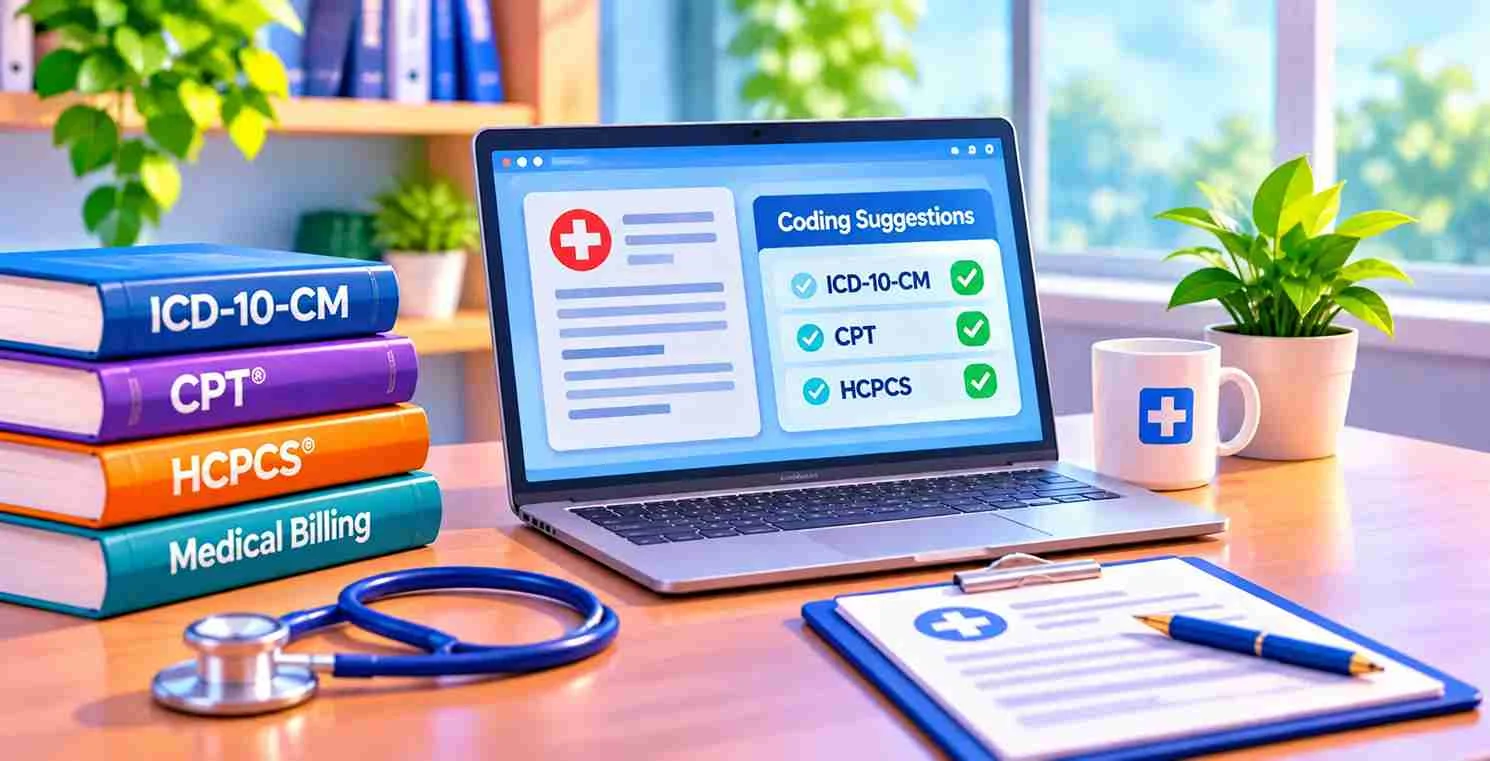
Some healthcare organisations already use computer-assisted coding systems, while others are evaluating or adopting AI-assisted workflows.. These tools use natural language processing to read clinical notes, suggest likely codes, and flag missing or inconsistent information. For simple, well-documented encounters, the software can often propose the right codes in seconds.
This changes what a coder does all day. Instead of searching for every code from scratch, a coder increasingly reviews, verifies, and corrects what the software suggests. Productivity expectations rise, and the work moves from data lookup towards judgement and quality control.
In practical terms, AI is changing three things:
- Speed. Routine charts are processed faster, so teams can handle more volume.
- The nature of the task. The coder’s role shifts from finding codes to checking them.
- The skills employers ask for. Familiarity with AI-assisted tools is becoming an increasingly useful skill in modern coding workflows.
Will AI Replace Medical Coders?
AI is changing medical coding workflows and may automate some routine coding tasks. However, complex documentation, coding guideline interpretation, validation, audits and compliance still require professional knowledge and review. The extent to which AI will affect medical coding employment remains uncertain.
AAPC, the body behind the CPC credential, makes a similar case. It argues that AI will support coders rather than replace them, because clinical documentation is full of ambiguous abbreviations, local jargon, and subjective statements that need human interpretation. Coders also remain essential for checking compliance with coverage rules, catching claim errors, and filing appeals, and privacy and security concerns add another layer of difficulty for full automation.
Here is why human coders remain essential:
- Clinical documentation is messy. Notes can be incomplete, contradictory, or unclear. Software can misread context, and a trained coder knows when something does not add up.
- Rules vary and keep changing. Coding guidelines are updated regularly, and payers and countries apply their own requirements. Applying them correctly takes interpretation, not just pattern matching.
- Someone has to be accountable. Healthcare organisations are responsible for the claims they submit. They need qualified professionals who can review and stand behind the coding.
- Audits and denials need reasoning. Investigating why a claim was denied, or whether a pattern of errors exists, requires analysis and communication that automation cannot fully handle.
- Providers sometimes need to be queried. When documentation is unclear, a coder has to raise a question with the clinician and interpret the answer.
Now the other side, because we believe you deserve the full picture. Roles that consist only of simple, repetitive coding may shrink over time. A coder who never learns to audit, review AI output, or handle complex cases could find their options narrowing. Some industry commentators expect automation to move faster than others do, so it is wiser to plan for change than to assume nothing will shift. The safest strategy is not to ignore AI. It is to learn to work with it.
What Skills Do Medical Coders Need in 2027?

The fundamentals have not changed. What has changed is the extra layer on top of them. A well-prepared coder in 2027 should have:
- Strong foundations in anatomy, physiology, and medical terminology.
- Working knowledge of ICD-10-CM, CPT, and HCPCS Level II, along with official coding guidelines.
- AI tool literacy, meaning the ability to use computer-assisted coding software and to spot when its suggestions are wrong.
- Auditing and quality review skills, including how to check accuracy and identify error patterns.
- Analytical thinking to interpret documentation and resolve conflicts between notes.
- Clear communication, especially when writing provider queries or working with a team.
- Attention to detail and steady focus, because accuracy is the core of the job.
- A habit of continuous learning, since codes, rules, and tools keep evolving.
Certification adds credibility on top of these skills. The CPC credential from AAPC is widely recognised in the industry, and many employers look for it when hiring freshers. The BLS also notes that employers may prefer to hire medical records specialists who hold a certification.
Medical Coding Career Paths and Salary Outlook
Medical coding is not a single job. It is a starting point with several directions to grow in:
- Medical coder
- Coding auditor
- Quality analyst
- Denial management specialist
- Clinical documentation improvement (CDI) specialist
- Team lead or coding manager
- Trainer or compliance specialist
Salaries vary widely depending on the city, employer, certification, specialisation and experience. AAPC’s 2026 Medical Coding and Billing Salary Report, based on 2025 US survey data, found that certified medical records specialists reported average annual earnings of $67,260, compared with $55,721 for non-certified respondents a difference of approximately 20.7 percent. Those holding three or more AAPC certifications reported an average of $81,227. These figures cover a broader group of healthcare records and revenue-cycle professionals, not medical coders alone, and represent US survey results rather than expected salaries in India.
Please note that these are US dollar figures from US survey participants, so they are not a guide to what you will earn in India. Pay in Kerala and across India depends on the employer, the city, and the role, so check current job postings and ask any institute for verified placement and salary records.
Who Should Choose Medical Coding?
Medical coding tends to suit people who:
- Enjoy detail-oriented work and take pride in accuracy.
- Like reading, analysing, and solving small puzzles.
- Prefer a desk-based role in healthcare without direct patient care.
- Are comfortable learning new tools and updating their knowledge regularly.
Life science, nursing, pharmacy, and allied health graduates often find the subject familiar. That said, people from other backgrounds can succeed too, provided they invest time in anatomy and medical terminology first. If you dislike sitting for long periods or find repetitive, detail-heavy work draining, it is worth thinking carefully before you commit.
How to Choose the Right Medical Coding Institute
The institute you pick shapes how prepared you are on your first day at work. Use this checklist when comparing options:
- Recognised certification alignment. Look for training that prepares you for respected credentials such as AAPC’s CPC, ideally from an AAPC-approved centre.
- A curriculum that includes AI. Ask whether you will actually work with AI-assisted coding tools, not just hear about them in a lecture.
- Practical training. Real-style charts and live practice build the speed and accuracy that employers expect.
- Experienced trainers. Find out whether the people teaching have worked in coding or RCM themselves.
- Exam support. Good institutes help you prepare for certification, not just finish a syllabus.
- Transparent placement support. Ask to see placement records, hiring partners, and the kind of roles students have actually joined. Be cautious about vague promises.
- Clear information. Fees, duration, eligibility, and batch details should be easy to get without pressure.
How Anton’s MediCode, an AAPC Licensed Education Provider Prepares You for AI-Era Coding
Anton’s Medicode is an AAPC Licensed Education Provider and AAPC-certified training centre in Kerala. Our Medical Coding & Billing with AI Integration programme is built around the reality described in this article. You learn the core code sets properly, and you also learn to work alongside the AI tools used in real-world coding environments, instead of competing with them.
Course at a glance:(As of NOV 2026)
- What you study: Anatomy, ICD, CPT, HCPCS, and Medical Billing, along with insurance claim procedures and regulatory compliance.
- AI integration: An introduction to the AI tools used in real-world coding environments, with hands-on practice in both manual and AI-assisted coding workflows.
- Practical exposure: Live project exposure, claim simulation labs, and industry-relevant software training.
- Certification focus: A curriculum aligned with the latest coding guidelines to prepare you for international certifications and job roles.
- Class modes: Offline, online, or hybrid.
- Duration: 3 – 4 months.
- Fees: ₹28,000 + GST for offline classes and ₹25,000 + GST for online classes, with instalments available.
Beyond this programme, we also offer pathways in Australian Clinical Coding, UAE RCM, and Healthcare RCM for those who want to specialise, along with exam preparation support and placement guidance. If you would like to know which course fits your background and goals, send an enquiry through our website or call us directly. There is no pressure to enrol. Fees and batch details can change, so please confirm the latest information with our team.
Is medical coding a good career for freshers in 2027?
Yes, if you prepare properly. Freshers who combine certification, hands-on practice, and AI tool familiarity are in a much stronger position than those who rely on theory alone.
Will AI replace medical coders?
AI is unlikely to replace coders entirely. It automates routine coding, while humans remain responsible for reviewing output, handling complex cases, supporting audits, and ensuring compliance.
Do I need a medical background to become a medical coder?
Not necessarily. A medical or life science background helps, but a good training programme teaches anatomy and medical terminology from the start.
Which certification should I aim for?
Many freshers aim for the CPC credential from AAPC, which is widely recognised. Another option is the CCS from AHIMA. The right choice depends on the kind of role and employer you are targeting.
Can medical coders work from home?
Yes, increasingly. AAPC’s 2026 salary report found that 64.8 percent of surveyed US medical records specialists work fully remote and another 15.4 percent work hybrid. Even so, many freshers begin in an office setting where they receive supervision and feedback, and remote options usually grow with experience and proven accuracy. These figures represent US survey respondents across a broad group of medical records specialists and should not be interpreted as the percentage of medical coding jobs available remotely in India.
How do I choose between medical coding institutes?
Compare certification alignment, AI-integrated training, practical exposure, trainer experience, exam support, and verifiable placement records, rather than judging on fees or promises alone.
Where can I learn Medical Coding and Billing with AI integration in Kerala?
Anton’s MediCode offers Medical Coding and Billing training with AI integration in Kerala. The programme covers essential medical coding systems such as ICD, CPT and HCPCS, medical billing concepts, and an introduction to AI-assisted coding workflows. Students can explore available online and classroom training options.
Explore the Medical Coding Course at Anton’s MediCode to learn more about the course and training options.
Final Thoughts : Is Medical Coding a Good Career in 2027
So, is medical coding a good career in 2027? Yes, for people who are willing to grow with it. AI is not the end of the profession. It is the next stage of it. The coders who thrive will be the ones who understand the codes deeply, use AI tools confidently, and bring the human judgement that software cannot replace.
If that sounds like the kind of career you want, the best next step is choosing training that reflects where the industry is heading. Talk to our team at Anton’s Medicode about our Medical Coding & Billing programme with AI integration, and take your first step towards a career that is built for the future.
Sources and Further Reading
- U.S. Bureau of Labor Statistics – Medical Records Specialists: Occupational Outlook Handbook — Employment outlook, job responsibilities and qualifications.
- AAPC – 2026 Medical Coding and Billing Salary Report — Salary trends, certification and remote-work survey findings.
- TechTarget / RevCycle Intelligence – How AI is Becoming a Staple in Medical Coding, Auditing — AI-assisted coding, workflow automation and the continuing role of human review.
- AAPC – AI and Medical Coding Resources — Further industry guidance and professional resources.
Statistics and source information last reviewed in November 2026. Employment and salary figures are based on U.S. data and should not be interpreted as direct forecasts of salaries or job availability in India.